Ligang Water Intake Project
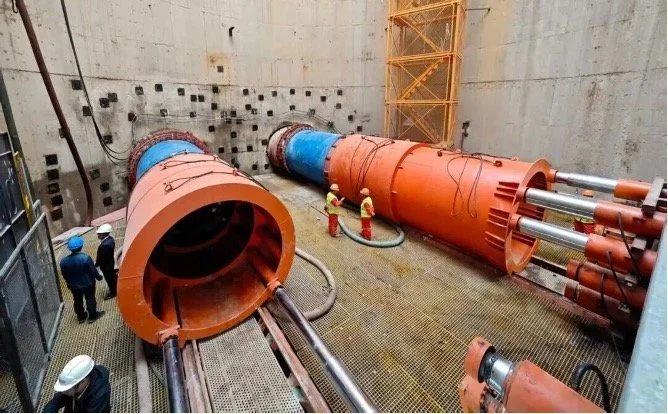
DN2600 Steel Pipes
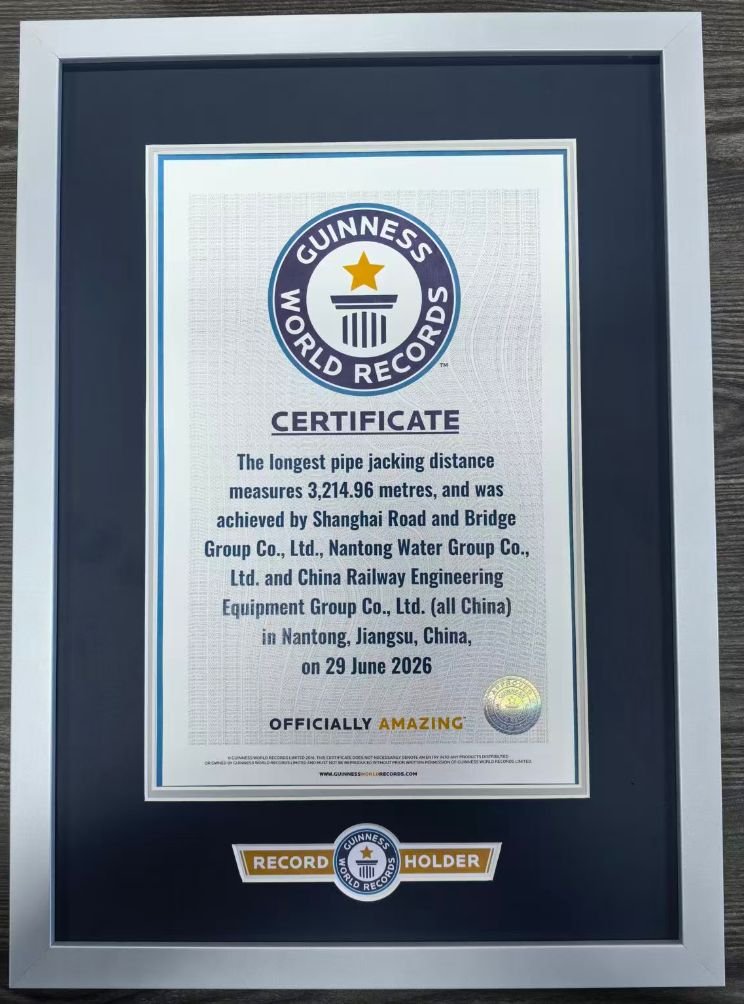
3,214.96m Single-drive Jacking Length
World record for single-drive installation of large-diameter steel pipe
Project Year: 2026
Project Overview
The Ligang Water Treatment Plant is situated on the floodplain outside the Yangtze River embankment in Wujie. With a planned total capacity of 1.2 million cubic meters per day, the facility's Phase I construction is designed to deliver 400,000 cubic meters per day.
Upon completion, the plant will supply higher-quality water to Nantong and the surrounding region, while also meeting the industrial water demands of PetroChina's Blue Ocean New Materials Project.
Engineering Challenges
The underwater pipe-jacking works represent the most technically demanding component of the Ligang Water Plant Water Intake Project. This section comprises twin DN2600 steel pipes driven in parallel, with a single-drive jacking length of 3,210 m — a distance expected to set a new world record for the longest single-drive installation of large-diameter steel pipe.
The drive originates at Working Shaft No. 2, advancing several kilometres beneath the bed of the Yangtze River before receiving at the water intake structure positioned mid-river. Buried at depths exceeding 40 m at peak, the works must contend with extreme hydrostatic pressure, complex and variable geological conditions, and the added constraint of crossing beneath active navigation channels.
Engineering Requirements
Initially, the client adopted a traditional bentonite lubrication strategy of injecting a thin slurry layer around the pipe sections and a thicker slurry around the outer shell of the pipe-jacking machine, with a replenishment rate of 300%.
As the drive progressed, the measured jacking force exceeded the combined theoretical load — the sum of 1 tonne per metre of jacking distance, the self-weight of the machine, and the breakout resistance — indicating that actual frictional resistance was higher than anticipated.
The core technical challenge therefore became threefold: reducing frictional resistance along the drive, maintaining slurry stability over the full jacking length, and minimizing the volume of slurry replenishment required.
Jello-Mud Results
Thrust force data remained consistent throughout the pipe-jacking drive. Prior to the introduction of Jello-Mud, the jacking force was recorded at 8,000 kN at a cutterhead injection volume of 300% with traditional bentonite slurry. By the 78th pipe section (702m excavated), following Jello-Mud application from the 77th section onward, this had dropped to 6,778 kN and 150% injection, representing an immediate reduction of approximately 15%.
The project conditions are demanding: a 40 m overburden bearing down on a water-saturated sand layer presents significant geotechnical risk. Despite this, continuous Jello-Mud injection throughout the drive has delivered a marked and sustained reduction in frictional resistance.
The project maintains a jacking rate of 1.5 pipe sections per day — equivalent to approximately 13.5 m of daily advance — with Jello-Mud replenishment stations installed at 1 km intervals along the drive.
Jello-Mud was able to lower the thrust force per section installation from 1ton to 0.6ton
No inter-jacks used for left line. Right line used inter-jack once through out the drive due to prolonged downtime.