
Mississauga East to West Diversion Trunk Sanitary Sewer – Contract 2
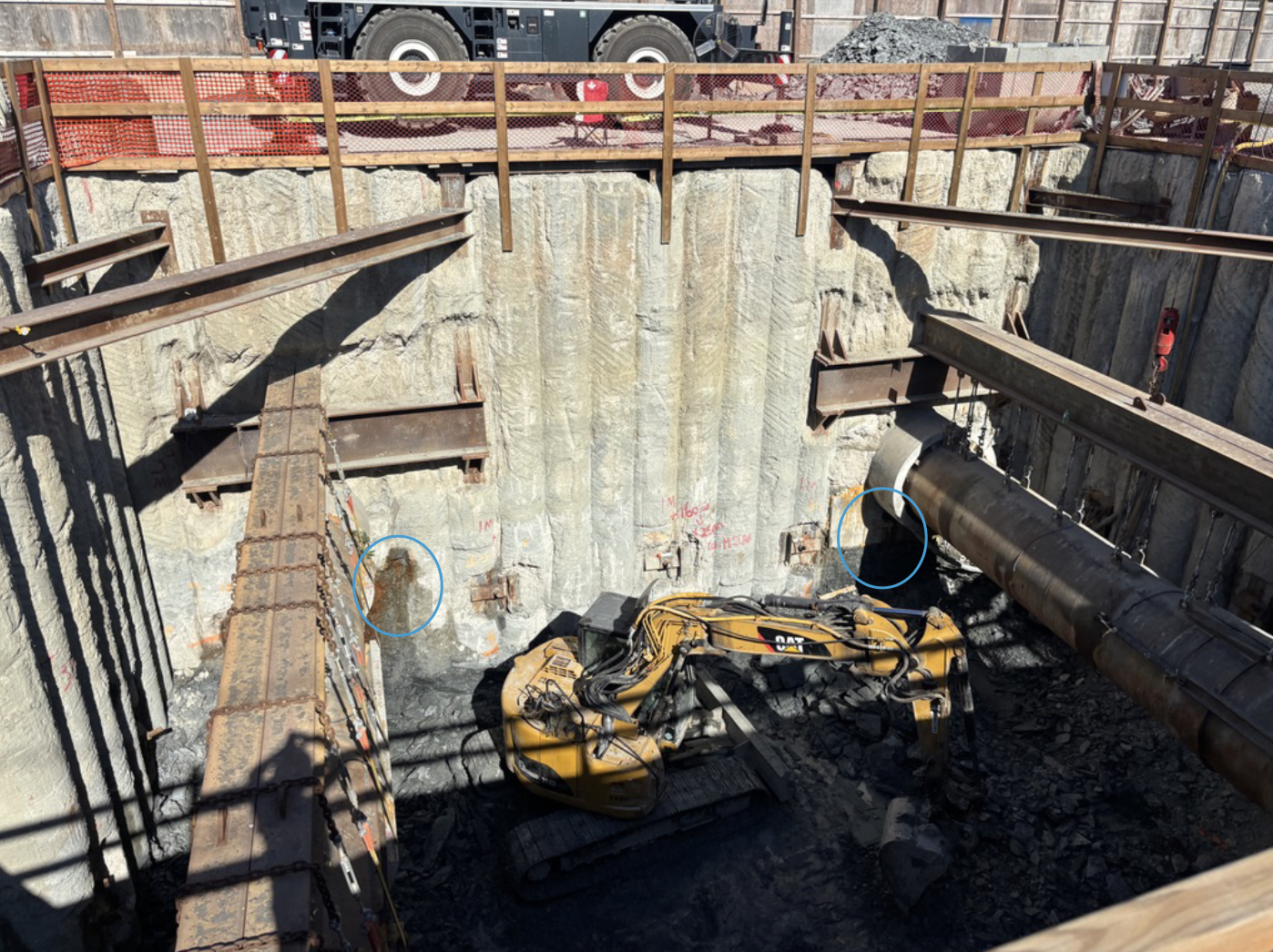
Secant Pile Wall Leak
Project year: 2025
Project Summary
This is a key infrastructure project in Mississauga, Great Toronto Area. This secant pile shaft is a receiving shaft for the tunnel boring machine and to facilitate the construction of a large diversion chamber. Adjacent to shaft area is Spring Creek which feeds the ground water in the area.
The existing sanitary pipes were previously constructed via open trench method and backfilled with permeable fill around the pipe and thus creating significant challenges for maintaining a tight seal at the secant pile wall – pipe penetration area.
Construction Difficulties
The permeable fill around the pipe penetration allowing significant inflow of ground water into the shaft.
Continuous groundwater leakage from the gaps, with an inflow rate of about 3 m³/h.
Water accumulation inside the working shaft worsened the operating environment.
Prolonged leakage risked soil loss, potential ground settlement, and additional discharge costs.
Previous attempts using cement and polyurethane grouting were ineffective in stopping the water.
Client Requirement
Rapid Sealing: Immediate control of leakage to restore a safe working environment.
Reliable Waterproofing: Stable long-term sealing to ensure safety throughout tunnelling.
Ease of Application: Simple construction process compatible with a tight schedule.
Cost Efficiency: Controlled overall cost to avoid repeated remedial work.
Jello-Mud Results
Preparation:
Clean the area around the portal. Install 2-inch injection pipes at the 2 o’clock, 4 o’clock, 8 o’clock, and 10 o’clock positions outside the portal segment for Jello-Mud injection.
Injection:
Mix 950 L of water and 160 kg of bentonite evenly in a mixing device. Then add BSP 70 at 6 kg/m³ (0.6%), and continue stirring to form the Jello-Mud slurry.
Inject the slurry through the pre-installed 2-inch pipes into the ground voids, proceeding from bottom to top with a grouting pump
During injection, keep the ball valve at the 2 o’clock or 10 o’clock point open to allow pressure relief and flow balance.
This process ensures a dense, continuous sealing ring around the leakage area, effectively stopping water ingress.
Final Verification:
Leakage is greatly reduced, and the working face is restored to a safe condition, solving a long standing issue for the client.