Jello-Mud vs Bentonite Slurry for TBM and Pipe Jacking Lubrication
Bentonite slurry is the standard midshield lubricant for shielded TBM tunnelling and pipe jacking, and it works well in many soils. In permeable, water-bearing ground, or under high water pressure, a thin slurry can dilute, migrate or wash away. Jello-Mud is a bentonite-based grout: the next generation bentonite grout system. It starts from bentonite slurry, adds BSP 70, and sets into a stable, Jello-like layer that lubricates, supports the ground and blocks water. This page compares the two so you can decide which one your drive needs. The full product page is Jello-Mud lubricating annular grout.
- Bentonite slurry: a proven, familiar base for lubrication, and often enough on short drives in tight, stable ground.
- Additives: a way to adjust viscosity and fluid loss, with results that depend on the product and the geological conditions.
- Jello-Mud: a bentonite-based grout built to stay in the overcut, for TBM and pipe jacking drives where water and permeable soil would carry a thin mix away.
How Bentonite Injection Provides Lubrication for Shielded TBM Tunnelling and Pipe Jacking
Successful pipe jacking demands low skin friction, and so does a shielded TBM drive. On a long drive, much of the load is skin friction resistance: the friction between the pipe or shield and the surrounding soil. Bentonite is a natural clay that forms a pumpable slurry with water and gels when it rests. Injected into the annular gap, it puts a fluid layer at the soil-pipe interface and lowers the friction coefficient. Reducing friction is the whole job. Many crews meter the slurry injection with an automatic lubrication system.
Bentonite Lubrication on a Shielded TBM
On a shielded TBM, bentonite is pumped through ports in the midshield into the gap between the shield and the ground. It lowers the thrust force the machine needs, supports the ground around the shield and helps hold the machine on line. TBM drives are bigger and longer than most pipe jacking drives, so the lubricant has to last longer too.
Bentonite Lubrication for Pipe Jacking
On a pipe-jacking drive, the bentonite slurry fed through ports along the pipes puts a fluid layer around the jacked pipe. Every pipe added to the tunnel adds contact area, so friction grows with distance. Microtunnelling is the same method, and the same rules apply.
Both work best where the ground holds the slurry in place: fine, low-permeability soil, modest groundwater pressure, and drives short enough for the ports to keep the overcut full. In those conditions a well-managed bentonite system is a sound choice. Jello-Mud is itself made from bentonite, so the base material stays in the plan.
Effect of Bentonite Slurry Pressure on Interface Friction
The film only lowers friction while the slurry pressure in the overcut stays above what the ground pushes back with. That support pressure keeps the cavity open and lowers the frictional stress on the pipe. Low pressure lets the cavity close onto the shield or pipe. Very fine, stable soil usually needs only plain bentonite. In coarse, permeable sand, silt, pebbles and gravel, the ground cannot hold a thin slurry. Pressure drives the slurry into the soil, where pore water dilutes it and carries it away. Friction is time-dependent too: it builds while a drive stands still. The usual response is more pumping, which adds volume without fixing the cause. Reducing the friction for the whole drive means keeping the injected lubricant in the gap. A denser mix, with a higher unit weight, also adds buoyancy, which helps hold line and level.
High Water Pressure and Deep Tunnels
The deeper the tunnel, the higher the water pressure. High water pressure dilutes bentonite slurry even faster. It does not dilute Jello-Mud. On deep drives with a slurry TBM, Jello-Mud helps keep the slurry in place.
Additives are the common middle step. Polymers and other products can change the rheological properties of the bentonite, and they help in some conditions. They can still leave the gap with the slurry when water and permeable soil move the mix out. In Balsam's own comparison, polymer additives do not hold the gap as well as BSP 70. The right test is whether the layer survives in your prevailing ground conditions, not how the mix looks in the tank.
How Jello-Mud Differs From Bentonite Slurry With Additives
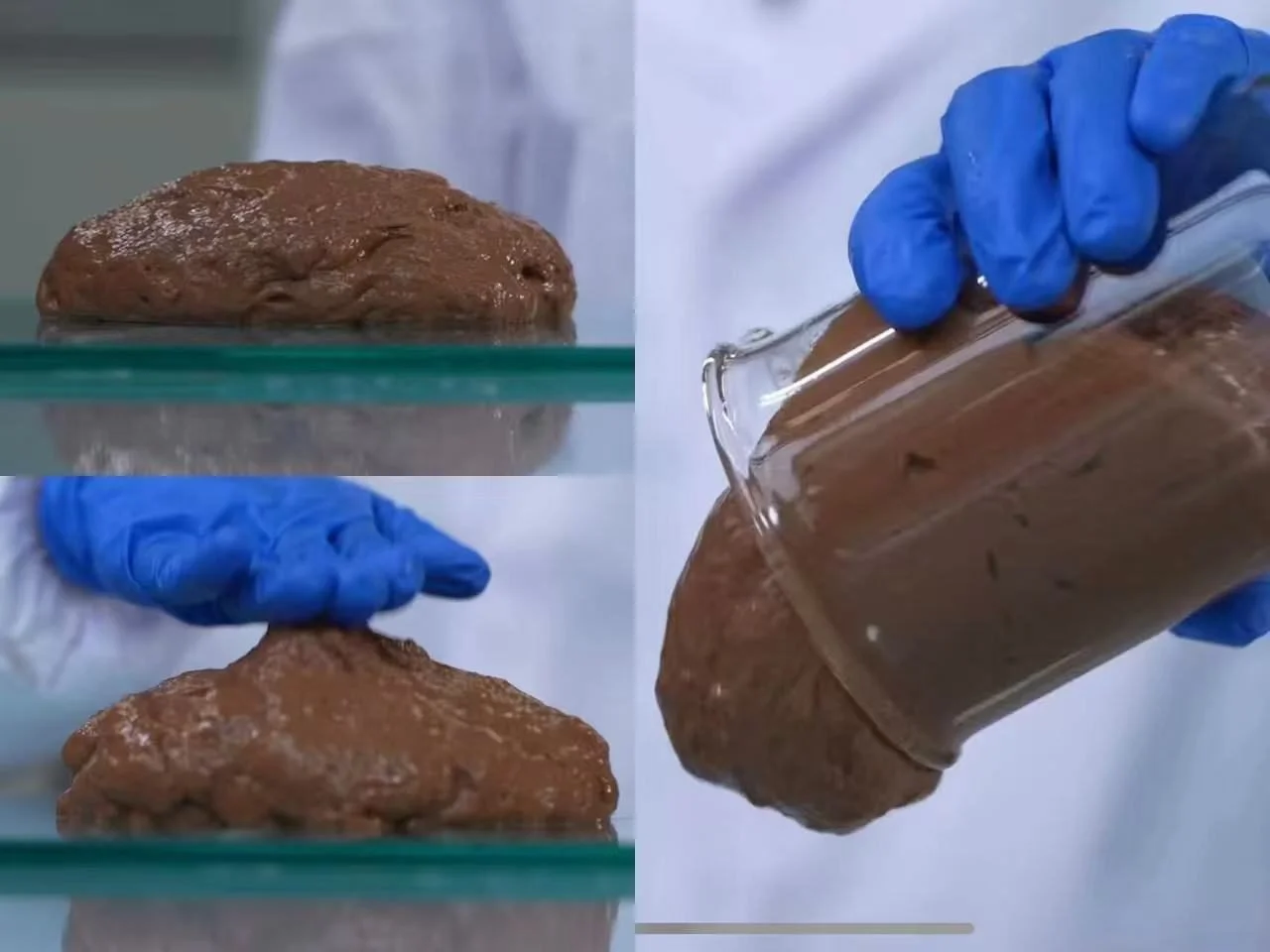
Jello-Mud is built on bentonite. Crews keep the bentonite they already use and add BSP 70 to it. It starts from bentonite slurry, needs no hydration wait and is ready in minutes. The result is a stable, Jello-like layer rather than a watery fluid. It can replace plain bentonite slurry as the lubrication fluid. Injected into the annular space around the shield or pipe, it does three jobs with one material:
- Lubrication: lowers friction and helps control thrust force on a TBM and total jacking force on a pipe jacker.
- Settlement control: fills and supports the gap, which limits ground loss under airports, roads, homes, gas pipelines and nearby tunnels.
- Water ingress and high water pressure: builds a filter cake that keeps high-pressure groundwater out. It passed a 5 bar water pressure test for 31 days with no leakage.
- Gas blocking: forms a barrier in the mud chamber of an EPB TBM, so dangerous gas cannot enter the tunnel.
- Eye seal at launch and receiving: seals the portal at both ends of the drive.
- Extended stoppage control: holds chamber pressure through long stops.
The mix can also be tuned for a more lubricating texture or for more settlement and pressure control, and changing one does not significantly cost you the other. Crews keep the same simple mixing tank and piston pump. We call the full approach the Jello-Mud Construction Method.
This video shows a pulling test in our lab. Jello-Mud needed 85% less pulling force than bentonite.
Lubrication for Pipe Jacking and TBMs Compared: Bentonite, Additives and Jello-Mud
| Factor | Bentonite Slurry | With Additives | Jello-Mud |
|---|---|---|---|
| What it is | Natural clay mixed with water | Slurry with added products | Bentonite slurry plus BSP 70 |
| Permeable, water-bearing ground | Can dilute, migrate or wash away | Depends on the additive and the ground | Designed to stay stable in sand, silt, pebbles, gravel and clay |
| High water pressure | Dilutes faster as depth increases | Depends on the additive | Resists dilution |
| Shielded TBM | Standard midshield lubricant | Used to adjust flow properties | Lowers thrust, holds chamber pressure, controls settlement |
| Jobs in the annular gap | Mainly lubrication | Mainly lubrication, with adjusted flow properties | Lubrication, settlement control and water control |
| Pressure test | Leaked and was penetrated by pressure right away | Leaked and was penetrated by pressure right away | 5 bar held for 31 days with no leakage |
| Toxicity | Natural clay, not toxic | Some additives may be toxic. Check each safety data sheet | Tested for LC50 |
| Equipment | Mixing tank and pump | Mixing tank and pump | Simple mixing tank and piston pump |
| Ligang drive, injection rate at the switch | Pure bentonite was not used | 300% (bentonite plus thick slurry) | 150% |
| Ligang drive, jacking force | Pure bentonite was not used | 8,000 kN at 693 m, above the design threshold | 6,778 kN |
Lab Tests: Jello-Mud vs Clay-Shock, a Two-Part Bentonite and Sodium Silicate Product
This industry standard product mixes bentonite with sodium silicate in two parts. It forms a thick slurry that hardens to stay in place. Jello-Mud is more cohesive. We tested both side by side in our lab. Comparison data is available on request.
In the constant pressure test, Jello-Mud sat on sand and gravel with a permeability of 2.36 x 10⁻³ m/s under 5 bar for 31 days. It penetrated 2 cm, with no leakage.
This video shows a water dissipation test. Jello-Mud lost a negligible amount of water and stayed stable.
Field Results: Shielded TBM and Pipe Jacking Projects
Ningbo Jintang: TBM Thrust With and Without Jello-Mud
On the Ningbo Jintang ocean-crossing tunnel, one of the deepest TBM tunnels in the world, thrust force was recorded on rings 174 to 179 with and without Jello-Mud. The rings excavated with Jello-Mud took 15% less thrust. Around the 14.57 m slurry shield, the chamber also held 4.35 bar through a 20-day shutdown.
Shenzhen-Huizhou Intercity Railway: Spewing Stopped Within 1 Day
In 2024 a 9.13 m EPB TBM met fissured, weathered sandstone and fault zones with low clay. The tunnel ran inside the water table. That matters, because many projects around the world have a water table close by. Groundwater diluted the cement grout and polyurethane the crew injected. The screw conveyor spewed water and soil, and the project was halted for 12 months. Jello-Mud solved the spewing within 1 day, and air pressure held at 4.1 bar. The Shenda T4 tunnel shows the same result under an airport.
Ligang Water Intake: Same Drive, Two Lubricants
The Ligang drive is the cleanest side-by-side because the lubricant changed mid-drive. Twin DN2600 steel pipelines were jacked under the Yangtze River, more than 40 m deep, through water-saturated sand. The drive began on traditional bentonite slurry, mixed with a thick slurry. At segment 77, 693 m in, jacking force reached 8,000 kN and passed the design threshold, so the contractor switched to Jello-Mud immediately. By segment 78, force was 6,778 kN, about 15% lower within 1 segment. With Jello-Mud, the force stayed under the design threshold for the rest of the world record drive.
A pipe jacker pushes the whole tunnel, so every new pipe should raise the jacking force. At segment 78 one more pipe was added, and the force still fell 15%. TBM thrust works differently, because a TBM only pushes itself, so the two numbers are not directly comparable.
- Void injection for the whole drive was about 50% less with Jello-Mud than with the bentonite approach.
- Specific skin friction sat between 0.50 and 0.75 kPa. The Bentonite Handbook: Lubrication for Pipe Jacking rates that band "extremely good (rare)".
- Heavy groundwater washed the plain slurry away. It did not wash Jello-Mud away.
- No intermediate jacking station was used on either line: 3,214.96 m on the left and 3,208 m on the right.
- The contractor estimated the drive could have gone about 4,000 m. The limit was the maximum force the steel pipe could take.
Shanghai Taopu: Proof That the Layer Resists Dilution
A 4.91 m Komatsu slurry shield tunnelled through silty sand in a strongly permeable artesian aquifer. At the portal, Jello-Mud extruded through the reserved holes with no gas or liquid leakage, and the contractor saved 85% of the portal-sealing material budget compared with cement grout. Extruded Jello-Mud looked like fresh Jello-Mud from the pump, which points to its resistance to dilution.
Mississauga: A Leak That Cement and Polyurethane Missed
Groundwater was entering a secant pile shaft at a pipe penetration at about 3 m³ per hour. A secant pile shaft does not usually leak like this. A previous contractor had used a permeable fill where an impermeable one was needed. Earlier cement and polyurethane grouting had not stopped it. Jello-Mud was injected through 1 port into the leak point. Leakage fell 80% right away, and the contractor could then seal the secant pile wall with concrete.
Nanjing Yangtze River Crossing: A Launch Seal in Half a Day
An 11.64 m TBM launched into an artesian aquifer under the Yangtze River. Against the traditional seal, Jello-Mud, made from bentonite slurry and BSP 70, needed only a fraction of the fill and half a day. Portal sealing was significantly cheaper than with tail seal grease, and no leakage was seen after the first ring.
Guanghua River Crossing: Holding Face Pressure With Less Air
With a Jello-Mud ring around the shield, the TBM was able to hold the designed face pressure, unlike plain bentonite injection, which bleeds away in the same ground.
How to Choose Between Bentonite, Additives and Jello-Mud
Match the product to the geotechnical picture and the drive, not to habit. Shielded TBM and pipe jacking parameters such as drive length, diameter, thrust and jacking force all feed into the choice, and so do ground conditions and the pipe jacking method in use. Published guidance often gives suggested values for bentonite consumption quantities depending on soil types and pipe diameter, which is a useful start for planning and construction of a drive. A geotechnical review of the route comes first. After that, a few questions sort most projects, including larger diameter pipe jacking drives:
- Is the ground permeable and water-bearing? Sand, silt, pebbles, gravel and artesian conditions are where a thin slurry is most likely to leave the gap.
- Is the tunnel deep? Deeper means higher water pressure, which dilutes bentonite faster. On a deep slurry TBM drive, Jello-Mud keeps the slurry in place.
- Is the drive long? The longer the drive, the more a lost film costs in thrust or jacking load.
- Is the surface or the area sensitive? Under airports, roads and homes, or near gas pipelines and other tunnels, support in the annulus matters as much as lubrication.
- Will the drive stop? Soil squeezing is the biggest danger in a stoppage, and friction builds at restart. Jello-Mud keeps the slurry in a slurry TBM chamber and the compressed air in an EPB chamber for longer.
If the answers are mostly no, a well-managed plain mix is likely enough. If several are yes, ask for a comparison on your ground before you commit. Direct shear testing of soil against the pipe material and field monitoring of jacking operations, including jacking force measurement, are both reasonable ways to check any lubricant against its claims. Published friction values vary with soil type, so treat them as a starting point.
Research Results Behind the Comparison
Balsam Laboratory has published its findings rather than only marketing them. Houqi (Franck) Peng and Liang Zhu describe the technique in Application of Jello-Mud in trenchless tunnelling (CRC Press, 2025), and the work also appears on the NASTT Knowledge Hub. More case studies are available on request.
Bentonite Slurry and Jello-Mud FAQ
Is Bentonite Slurry Toxic, and Has Jello-Mud Been Tested for LC50?
Pure bentonite slurry is a natural clay and water mix and is not toxic. Some additives may be toxic, so check the safety data sheet for each one. Jello-Mud has been tested for LC50.
What Annular Space Grout Works Under High Water Pressure?
Plain bentonite injection is often pushed out of the gap when water pressure is high. Jello-Mud is built on the same bentonite, but it stays in place and builds a filter cake against the ground. It passed a 5 bar water pressure test for 31 days with no leakage.
What Is a Filter Cake, and Why Does It Matter?
A filter cake is the thin, low-permeability layer a bentonite grout builds against the ground. It is what keeps water ingress out of the tunnel. A thin slurry bleeds into sand and gravel before the cake can form. Jello-Mud holds its place long enough to build it.
Can Bentonite Grout Block Gas on an EPB TBM?
Jello-Mud can. It forms a barrier in the mud chamber of an EPB TBM, so dangerous gas in the ground cannot come into the tunnel.
Can an Annular Grout Be Adjusted to Different Ground Conditions?
Yes. Jello-Mud's ratio can be adjusted for a more lubricating texture or for more settlement and pressure control. Adjusting for one does not significantly reduce the other. Send your ground conditions, machine size and drive length and we will suggest a starting mix.
Does Jello-Mud Control Settlement?
Yes. It fills and supports the annular space, so the ground has less room to move. On the Shanghai Jing'an Temple pipe jacking drive, settlement stayed within ±10 mm as designed. On the super-shallow Longshui South Road river crossing, it stayed within millimetres.
Can Jello-Mud Seal the Eye Seal at Launch and Receiving?
Yes. On the Nanjing Yangtze River crossing, the launch seal took only a fraction of the traditional fill and half a day. On Singapore N109A there was no water leakage at the launch shaft or the reception shaft.
Does Jello-Mud Hold Chamber Pressure Through Long Stoppages?
Yes. At Ningbo Jintang the slurry chamber held 4.35 bar after a 20-day shutdown. Plain bentonite slurry loses pressure as it bleeds into the ground.
Does Jello-Mud Replace Bentonite Slurry?
Yes, as the lubrication fluid. It is still made from bentonite, so your crew keeps the same base material and equipment. Plain bentonite remains a sound lubricant in tight, stable ground.
What Equipment Do I Need to Pump Jello-Mud?
A simple mixing tank and a piston pump.
Can Jello-Mud Be Used on TBM Drives as Well as Pipe Jacking?
Yes, both. Ningbo Jintang and Shenzhen-Huizhou show it on TBMs. Ligang shows it on pipe jacking.
How Long Does Delivery Take?
BSP 70 has a quick turnaround. It ships by truck, rail or sea, and air freight is available. Safety data sheet and technical data are available on request.
Comparing lubricants for a TBM or pipe jacking drive in water-bearing ground? Send your ground conditions, machine size and drive length through the contact page and ask for technical data. Our team will come back with a recommendation your engineer can review. The Jello-Mud specifications and product details are on the product page.